Represent Parcel Not Updating? Fashionreps Troubleshooting
Inside this note
# Represent Parcel Not Updating? Fashionreps Troubleshooting  If you found [represent](https://fashion-reps.net/brand/represent) items through [fashionreps](https://fashion-reps.net/) and the parcel tracking on your order page has not changed in a long time, do not repeatedly submit shipping requests or guess the parcel's location based on days e
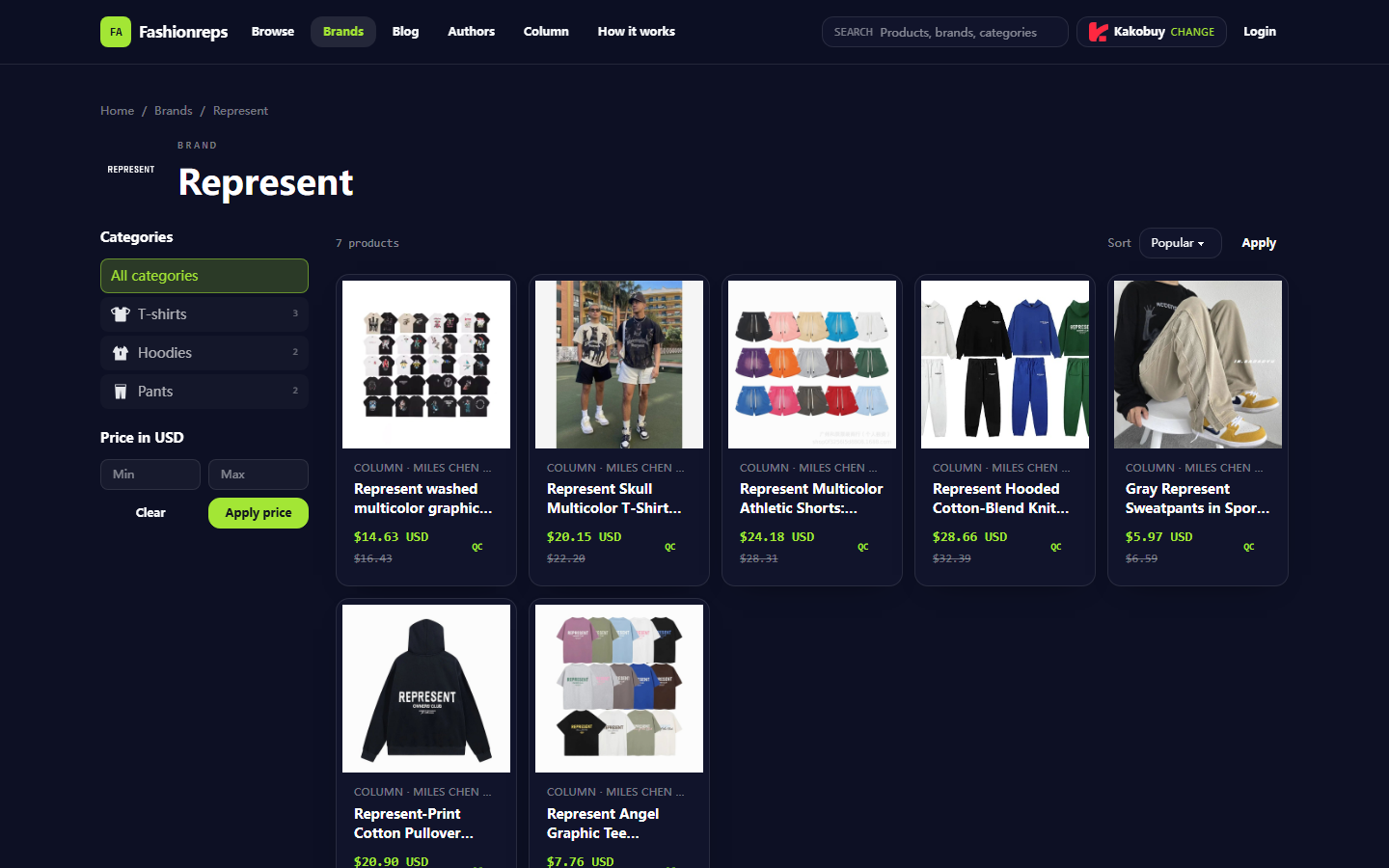

If you found represent items through fashionreps and the parcel tracking on your order page has not changed in a long time, do not repeatedly submit shipping requests or guess the parcel's location based on days elapsed. This guide addresses one problem: how to determine the current shipping stage when tracking records are not updating, whether you need to take action, and when to contact the relevant party.
This article helps you accomplish three things: preserve verifiable tracking evidence, distinguish between normal waiting and anomalies that require attention, and decide whether to keep waiting, contact the agent, or hold off on repeated actions. It does not apply to situations where the parcel is confirmed lost, you have received official customs notice, the address needs to be changed, or the platform page clearly shows refund and return. Those cases should be handled directly according to the order page and carrier notifications. 📦
Define the Specific Troubleshooting Task for represent Parcel Tracking Not Updating
"Tracking not updating" can mean different things: the tracking number is not recognized, the page only shows label creation, the warehouse shows shipped but the carrier has no scans, the parcel has been handed over but the destination has no new events, or the page prompts for additional information. They require different handling.
First, write the problem as a verifiable sentence, for example:
- "Tracking number generated, but carrier page has no initial scan."
- "Agent page shows shipped, but carrier page has no new events since a certain date."
- "Last record shows in transit, but destination country has no import or sorting record."
- "Tracking page prompts for address, tax, or recipient information confirmation."
After reading this article, you should be able to create a timeline and choose the next step based on evidence. Do not equate "no update" with "parcel lost," nor treat generic shipping times from search results as the current location of your parcel.
Record Parcel Number, Shipping Route, Last Update Time, and Page Source
First, save the original information from the order page and carrier page. Pages may update or clear old statuses, so take screenshots or copy text, but you must cover up name, phone number, full address, payment information, and unnecessary personal details from the order. 🔒
At minimum, record the following:
- Order number or item name for the represent product. Only keep necessary parts, do not disclose full order details.
- Parcel tracking number, check for spaces, letter case, or copying errors.
- Agent name, shipping route, parcel creation time, and displayed shipping time.
- Last status and its update time on the agent page.
- Last status and its update time on the carrier tracking page.
- Source name of the tracking page and access date. The verification date at the time of writing is October 9, 2026, but your order should be based on what you see on the page that day.
- Destination country or region, and currency, fees, or tax prompts shown on the order page. Do not infer your route based on experiences in other countries.
If the two pages show different statuses, record them separately. Do not merge them into one conclusion. The agent page may reflect internal warehouse or forwarding system nodes, while the carrier page may only show parcels that have been received and scanned.
Distinguish Label Creation, Warehouse Dispatch, Forwarding Handover, and Destination Scan Statuses
Tracking statuses can typically be divided into several stages based on evidence. Names may vary by agent or carrier, so the following categories are for troubleshooting, not a judgment of a specific parcel's current state.
Only Label or Waybill Creation Record
If the page shows label created, tracking number generated, or pre-advised, but no pickup, inbound, received, or initial scan record, this only proves that shipping information has been created. It does not necessarily prove the parcel has left the warehouse.
At this point, check:
- Whether the tracking number can be recognized on the carrier's official tracking page.
- Whether the agent page simultaneously shows shipped, handed to carrier, or only label created.
- Whether there are prompts for pending payment, route confirmation, consolidation, or warehouse processing.
- Whether the creation time is the same as the warehouse shipping time. A difference is not abnormal, but record them separately.
Without the first carrier scan, do not write "tracking number exists" as "parcel is in transit."
Warehouse Shows Shipped, but Carrier Has No New Scans
This usually means the agent system has recorded the shipment, but the carrier's public page has not yet shown a receiving event. Possible reasons include batch handover, cross-warehouse transfer, scan delay, route system switch, or tracking page temporarily not syncing.
Check the agent's original status text and time, then re-enter the tracking number on the carrier page. Do not refresh continuously or create repeated query requests; one record is enough for comparison.
If the agent page requires you to confirm the address, provide additional recipient information, or pay extra fees, handle the page's explicit requirements first, then wait for status sync. Do not pay the same fee again just because tracking is not updating.
Handed Over, but No New Events During Transit
If the carrier has already shown received, inbound, transfer, or departed origin, it means there is at least one public scan event. If there is no update after some time, it may just be a lack of per-stop scanning during transit, and does not alone prove the parcel is stuck or lost.
At this point, focus on:
- Which country or region the last record belongs to.
- Whether the status is in transit, in transfer, waiting for flight, waiting for customs, or exception.
- Whether the page requests the recipient to contact the carrier, submit documents, or pay taxes.
- How long since the last scan, and whether it exceeds the tracking window provided by the route or carrier.
Do not use the shipping speed of other orders to replace the evidence of the current parcel. Different routes, weekends, holidays, weather, flight schedules, and customs processes can affect update frequency.
No Import or Delivery Scan at Destination
If the parcel has left the origin, but the destination carrier's page shows no import, sorting, or delivery events, first check if the route uses a new local delivery tracking number. Some routes generate a second tracking number after transferring to a local carrier, but whether it exists and where to view it must be based on explicit prompts from the agent or carrier page.
If there is no new number and no request for action, save the current status and wait for a reasonable tracking window. Do not infer the parcel's location from social media comments.
Check Agent's Official Shipping Information and Carrier Visible Information
The fashionreps page provides product discovery and shopping process instructions. The purchase button on the product page leads to the shopping agent chosen by the user; orders, payments, and shipping are handled by the external agent website. Therefore, when tracking is not updating, you cannot only look at the fashionreps product page, nor treat the fashionreps product information page as the parcel tracking backend.
Check in the following order:
- Open the agent order details where you actually placed the order, confirm that the product, parcel number, route, and status belong to the same order.
- Check the agent's shipping help page or order prompts to understand the definition of the status, expected tracking window, and customer service entry.
- Use the carrier name or official tracking link provided on the page to verify public scan records.
- Compare tracking numbers, times, statuses, and destinations between the two sides, not just a short status headline.
- Save any discrepancies and ask the agent responsible for the order, rather than submitting repeated shipping requests on the product display page.
If the carrier page shows more recent information than the agent page, keep evidence from both sides and use the carrier's public scans as the current shipping record; if the agent page shows handed over but the carrier has no receipt record, ask the agent for handover proof or route status. Do not assert the parcel has left the warehouse on your own. 🧾
Check Address, Additional Information, and Exception Notifications for Required User Action
Sometimes tracking stalls are not about shipping speed but are waiting for the recipient to act. Check agent order notifications, in-site messages, email, and carrier notifications, but do not click on payment or information collection pages from unknown sources.
Look for these explicit prompts:
- Incomplete recipient address or needs confirmation.
- Incorrect phone or postal code format.
- Need to provide customs clearance documents, identity information, or recipient information.
- Need to pay taxes legally required by the destination country or processing fees clearly listed by the carrier.
- Parcel needs delivery appointment, pickup at a location, or contact with local carrier.
- Parcel marked as address exception, no one available, undeliverable, or awaiting return.
Only handle through your agent account, carrier official page, or customer service channels confirmed in the order. Do not publicly share full waybills, passports, payment cards, phone numbers, or addresses in order screenshots. Customs and taxes should be declared truthfully according to destination country rules; cannot solve tracking issues by under-declaring, splitting orders to avoid taxes, or evading inspection.
If no notification requires your action, do not arbitrarily modify the address, cancel the parcel, or purchase the same item again just because the status has stalled. Address changes usually require confirmation from the shipping party; submitting repeatedly without authorization may cause information conflicts.
How to Mark Unknown Instead of Guessing Parcel Location When No Real-Time Tracking Evidence
Troubleshooting records should distinguish among confirmed, unconfirmed, and needs inquiry information.
Confirmed information includes the tracking number, time, scan location, and status text clearly displayed on the page. Unconfirmed information includes the parcel's current city, whether it has been loaded onto a plane, whether it has passed customs, and the exact time of the next scan. Needs inquiry information includes whether the waybill was actually handed over, whether a new local tracking number was generated, and whether there are internal exceptions or route changes.
You can use a recording format like this:
- Confirmed: The last public scan on the carrier page occurred at a certain place and time.
- Unconfirmed: Whether the parcel has left that location; the page does not provide evidence.
- To inquire: Whether the agent has handed the parcel to the route carrier, and whether there is a new local tracking number.
Do not use judgments that cannot be supported by the page, such as "definitely at customs," "will update soon," or "already lost." The value of tracking troubleshooting is not to fill in unknowns, but to preserve unknowns until new verifiable evidence appears. 🔎
When to Contact the Agent, Carrier, or Hold Off on Repeated Request Submission
When neither the agent page nor the carrier page requires user action, first wait according to the last public scan and the route's tracking instructions. Do not refresh frequently or submit the same request repeatedly.
Situations suitable for contacting the agent include:
- Tracking number generated, but no initial scan for a long time, and the agent page cannot explain whether handover was completed.
- Agent shows shipped, but carrier page cannot recognize the tracking number continuously.
- Tracking numbers, destinations, or parcel statuses on the two pages are clearly inconsistent.
- Page shows route exception, return, address issue, or needs to reconfirm information.
- Carrier page requires handling through the shipper, and the recipient cannot submit an inquiry directly.
Situations suitable for contacting the carrier include:
- Official page shows clear exception, undeliverable, no one available, or pickup notice.
- Page provides a legitimate action the recipient can take.
- Parcel has entered the destination carrier network, and the page clearly gives customer service or location handling methods.
When contacting, provide only necessary information: order or parcel number, route, last scan time, page status text, and the question you want to confirm. Do not send full payment proof or disclose personal information publicly.
Situations to hold off on repeated submissions for shipping, payment, address change, or repurchase include:
- Existing parcel still has recent scan records.
- Agent has confirmed waiting for route or carrier sync.
- Page does not require creating a new parcel.
- You cannot confirm whether a new request will create a second parcel or duplicate fees.
Repeated actions may create two tracking numbers, increase costs and information conflicts, and make it harder for customer service to determine which request is valid.
Complete Follow-Up Handling Decision with Timeline and Question Checklist
Finally, organize a short timeline:
- Order confirmation time for the product.
- Time when warehouse completed packing or consolidation, if recorded on the page.
- Waybill creation time.
- Time when agent showed shipped or handed over.
- Carrier's first scan time.
- Most recent public scan time.
- Date when you last checked agent and carrier pages.
- Whether there are any address, information, tax, customs, or delivery notifications.
Then answer four questions:
- Is there at least one public carrier scan currently?
- Does the latest status explicitly require user action?
- Do the agent and carrier records belong to the same parcel?
- Will taking action now create duplicate fees or duplicate parcels?
If there are recent scans and no user action prompts, continue saving evidence and wait for the next reasonable update. If there is no initial scan or there is a status conflict, contact the agent responsible for the order. If the carrier has given a clear exception and a legitimate handling channel, submit necessary information through that channel. If the page shows formal return, loss, or customs notice, stop using this checklist and proceed to the corresponding claim, return, or compliance process.
This method does not promise that tracking will update at a certain time, nor does it determine the real-time location of your parcel. It mainly reduces repeated submissions, contacting the wrong party, and guessing without evidence. It is suitable for buyers who need to verify agent and carrier records themselves and are willing to save a timeline; it is not suitable for those who have received formal legal, customs, or carrier disposition notices.
Community feedback
0 approved
- No approved comments yet.