Polo Ralph Lauren Jackets: Fashionreps vs Google Sheets
Inside this note
# Polo Ralph Lauren Jackets: Fashionreps vs Google Sheets  This guide tackles a specific question: when you're looking for [Polo Ralph Lauren jackets](https://fashion-reps.net/jackets/polo-ralph-lauren) on Fashionreps, should you use the site's brand page to discover and do initial comparisons, or use Google Sheets to maintain a list of candidates? After r
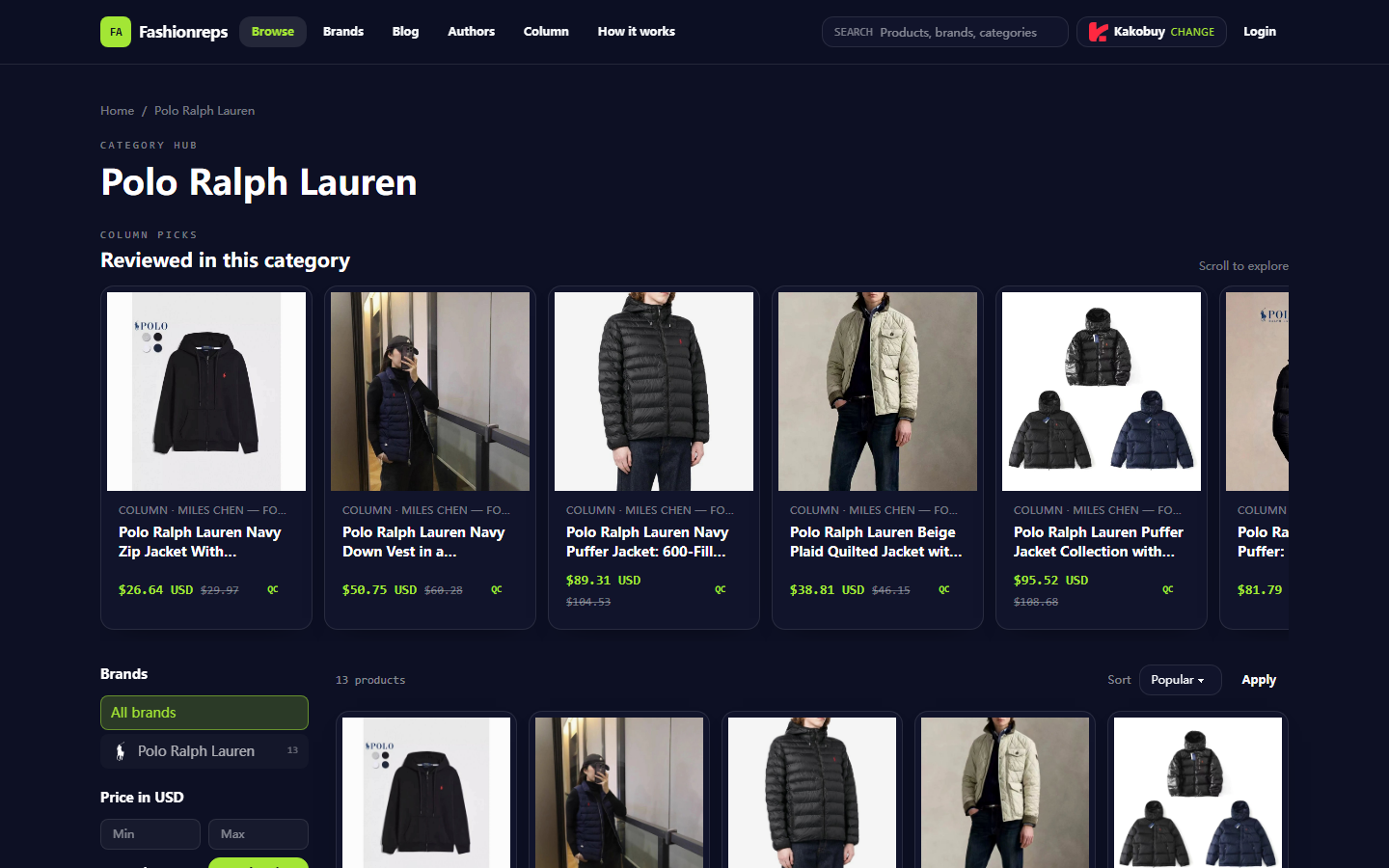

This guide tackles a specific question: when you're looking for Polo Ralph Lauren jackets on Fashionreps, should you use the site's brand page to discover and do initial comparisons, or use Google Sheets to maintain a list of candidates?
After reading, you'll be able to create a candidate list with style, color, size, reference price, product page status, and evidence location, then go back to the product pages to verify each item. This article does not apply to scenarios that require real-time inventory, final shipping costs, taxes, seller after-sales promises, or authenticity verification, because that information cannot be confirmed solely from the brand catalog page.
This article is based on the visible content of the Fashionreps Polo Ralph Lauren brand page on October 9, 2026. Prices, number of items, page entry points, and link statuses may change, so you should reopen the corresponding product pages to confirm before actually ordering. 🧭
What This Polo Ralph Lauren Jacket Brand Browse Comparison Solves
Fashionreps' brand page is suitable for answering "which Polo Ralph Lauren jackets are worth looking into further right now". The page uses brand categories as an entry point, showing product cards, product names, reference prices, and filtering options, with sorting methods such as Popular, Latest, Price: low to high, and Price: high to low.
Google Sheets is suitable for answering "which candidates have I already found, how do they compare, and which fields haven't been verified yet". It is not a product source, and it won't automatically prove inventory, size accuracy, or image authenticity; rather, it's for saving your judgment process and follow-up review tasks.
Therefore, the division of labor between the two can be summarized as:
- Fashionreps brand page is responsible for discovery, browsing, and opening product entry points.
- Product detail pages are responsible for verifying visible images, specs, prices, and purchase entry points.
- Google Sheets is responsible for organizing candidates, marking missing information, assigning review tasks, and recording update times.
- The final purchase decision should still be based on the currently accessible product page and the information displayed on the chosen purchase platform.
First Verify Fashionreps' Visible Brand Entry, Product Cards, and Link Fields
The visible Polo Ralph Lauren brand page includes a brand category entry, a quantity hint of 13 items, USD reference prices, previous reference prices, filters, and sorters. Product cards show more specific descriptions, such as style directions like Navy Zip Jacket, Down Vest, Puffer Jacket, Varsity Jacket, and Quilted Jacket.
The page also shows a purchase platform selection entry. The page explains that the Buy button on an item will lead to the user's chosen purchasing agent platform; selectable agents include multiple entry points such as Superbuy, Mulebuy, JoyaGoo, Sugargoo, CNFans, Pandabuy, and others. This entry indicates that the purchase path will be affected by the selected agent, but the page itself does not equal the agent platform's real-time quotes, inventory, or after-sales policies.
When browsing, it's recommended to first record the following visible fields:
- Whether the brand name is still Polo Ralph Lauren.
- Whether the product card title clearly describes a jacket, vest, down jacket, or coat.
- The current reference price and the previous reference price shown on the page.
- Whether the product card has a clear image and an openable product entry.
- Whether the page can proceed to product details, rather than staying on a category tag or blank page.
- Whether the Buy button leads to the expected agent path according to the current selection.
Product card names are often editorial descriptions and should not be directly taken as complete material proof. For example, if a title says "600-Fill Duck Down" or "Cotton Fill", you should still open the detail page to confirm whether the page provides corresponding descriptions, specs, or image evidence. 🔍
How the Site's Spreadsheet Helps Discover Jacket Candidates from the Brand Page
Here, "site spreadsheet" refers to the product catalog arranged in a grid or card format on the Fashionreps page, not a freely editable Google Sheets file. Its advantage is that it puts brand, images, titles, prices, and filter entries in the same browsing path.
When discovering candidates, you can start with a broad browse on the brand page, then narrow down to jacket-related items. A reliable sequence is:
- Enter the Polo Ralph Lauren brand category page.
- First browse all visible cards and exclude items that are clearly not jackets.
- Use price filtering or sorting to observe the price range and style distribution.
- Open candidate product pages with more complete title descriptions.
- Reconfirm images, specs, colors, and purchase entry on the product page.
- Only add it to your Google Sheets candidate record if the product page is still accessible.
Based on the current page content, you can prioritize dividing into a few categories: lightweight jackets, down vests, hooded down jackets, cotton-filled jackets, varsity jackets, and quilted jackets. This classification comes from page titles and visible descriptions and can only be used as an organizing dimension, not as proof of material or warmth performance from product details.
Don't decide first which style is "most worth buying" and then go back to find products that support it. A more reliable approach is to record page evidence first, then filter based on purpose, price, completeness of size information, and link status.
How Google Sheets Records Style, Color, Size, and Evidence Links
The core function of Google Sheets is to turn a single browsing session into a reviewable record. Each candidate gets one row, and each comparable attribute gets its own column, to avoid stuffing multiple pieces of information into one cell that can't be filtered.
Recommended fields are as follows:
| Field | Recording Method | Review Focus |
|---|---|---|
| Product Title | Keep the visible page title; you may add a short category | Do not arbitrarily change editorial titles to official model names |
| Style Category | Jacket, vest, down jacket, varsity jacket, etc. | Categorization should be based on page descriptions |
| Color | Record the color clearly shown in the title or detail page | For multi-color items, note whether there are per-color images |
| Size | Record the visible size range on the detail page | If not shown, mark as "to verify"; don't leave blank misleadingly |
| Current Reference Price | Record the USD amount shown on the page | Mark the verification date; don't treat it as final landed price |
| Product Page Status | Accessible, redirected, broken, pending review | Only keep candidates that are currently openable and have sufficient info |
| Image Evidence | Note whether images are clear and match the style | Don't treat image appearance as proof of material or quality |
| Notes | Write risks, missing fields, and next steps | Use short phrases for easy filtering later |
If you need to save the product page location, you can record the page title, scrape date, and internal notes in the sheet, rather than relying only on a copied text. After page structure or product entry changes, an old title alone may not locate the original product.
For sizes, it's recommended to separate "page has size chart", "only size options", and "no visible size information" into different statuses. The three have different evidence strengths and cannot all be written as "has size". For colors, also distinguish between "title states color" and "image looks like a certain color"; the latter needs to be marked as a visual judgment, not page spec.
Path Differences: Brand Browsing, Keyword Search, and Sheet Filtering
The three methods solve different problems: brand browsing is good for discovering a range, keyword search is good for finding specific descriptions, and sheet filtering is good for making decisions among already collected candidates.
| Path | Best Suited Task | Main Risk | Suggested Action |
|---|---|---|---|
| Brand page browsing | Understand the visible candidate range of Polo Ralph Lauren jackets | May miss items not in current sorting | Check categories and multiple sortings first |
| Keyword search | Find explicit styles like puffer, vest, varsity | Word match does not equal complete specs | Confirm detail page after opening results |
| Google Sheets filtering | Compare price, color, size status, and review progress | Old records may keep broken items | Add update time and status columns |
If you only want to find a black varsity jacket, keyword search may be faster than browsing card by card, but you still need to check whether search results come from the correct brand category. If you are comparing colors, sizes, and price status among multiple candidates, Google Sheets will be clearer.
If you don't yet know whether you're looking for a down jacket, vest, or lightweight jacket, browsing the brand page first is usually more sensible. It helps you form a candidate range and avoids narrowing search terms too much. ⚖️
How to Separately Verify Product Images, Specs, and Link Update Times
Images, specs, and links are three different types of evidence and cannot replace each other.
Image verification focuses on: whether the image exists, whether it is clear, whether it corresponds to the product title, and whether different angles show the same style. Images can help identify color, collar, hood, pockets, and quilting structure, but cannot alone prove fill, fabric composition, weight, or workmanship quality.
Spec verification focuses on: whether the detail page explicitly states material, fill, size, color options, and measurements. When a title mentions a material term, try to find an independent statement in the detail page. If you don't see specs, the sheet should say "not verified", not fill in based on appearance.
Link verification focuses on: whether the page is still accessible, whether it has a clear product name, whether it shows enough information to support comparison, and whether the purchase entry is still valid. The category page can be used to discover candidates, but broken product pages, blank pages, pure tag pages, and pages where the product identity cannot be confirmed should not be used as valid evidence.
In Google Sheets, it's recommended to set three date fields: discovery date, last verification date, and next review date. Prices, inventory, purchasing agents, and link status are all high-volatility information, so old records can only serve as historical reference. 🕒
Which Scenarios Suit Website Browsing vs Sheet Maintenance
Scenarios suitable for using Fashionreps website browsing include:
- First-time understanding of what Polo Ralph Lauren jacket styles exist.
- Needing to view product images and card titles.
- Wanting to browse candidates by popular, latest, or price order.
- Needing to enter specific product pages from the brand category.
- Wanting to confirm which purchasing agent entries the page provides.
Scenarios suitable for using Google Sheets maintenance include:
- Already collected multiple candidates and need horizontal comparison.
- Need to record verification status of different colors, sizes, and styles.
- Need to collaborate with others to assign review tasks.
- Want to keep historical changes in price and link status.
- Need to quickly exclude items with incomplete information or broken pages before purchasing.
It is not recommended to treat Google Sheets as a substitute for product pages. A sheet can save a page record, but cannot guarantee that the page will remain valid afterward, nor can it confirm final shipping, taxes, agent service fees, inventory, or after-sales policies for you.
Similarly, it is not recommended to rely only on the brand page to make a purchase decision. The brand page is suitable for discovery and initial screening, while the product detail page is a necessary step to verify specific images, specs, and purchase entry.
Verification Boundaries with Incomplete Catalogs or Broken Links
When the number of items shown on the brand page, the currently visible cards, and the actual results on detail pages are inconsistent, you should prioritize recording the discrepancy rather than guessing the cause. Possible situations include item removal, link changes, catalog updates, residual filter conditions, or temporary page loading failure.
When encountering incomplete information, you can handle it as follows:
- Page opens but lacks sufficient specs: keep as "to verify", don't write as a complete candidate.
- Product title is clear but detail page is broken: keep historical record and mark as "link broken".
- Image exists but color or size cannot be confirmed: mark missing fields separately.
- Reference price exists but no final costs: only record reference price, don't calculate landed price.
- Product redirects to agent platform but no inventory shown: don't write redirect success as in stock.
- Page shows brand name but no specific product: don't count brand tag page as valid product page.
These boundaries help avoid mistaking old records, visual guesses, or entry existence for purchaseable facts. For content that requires real-time confirmation, you should recheck when preparing to order and record a new verification date.
Final Action: Build Polo Ralph Lauren Candidate Record and Recheck One by One
Now you can start with a small-range list instead of recording all items at once:
- Select 3 to 5 jacket candidates from the Fashionreps Polo Ralph Lauren brand page.
- Create one row for each candidate, filling in title, style category, reference price, and discovery date.
- Open the product page and separately verify images, colors, sizes, and spec descriptions.
- Mark each field as verified, not shown, or pending review.
- Record the product page status; don't treat category page or old cache as valid product page.
- Filter based on purpose, such as lightweight smart-casual office, warm layer, vest, or casual jacket.
- Before preparing to purchase, recheck price, inventory, purchasing agent, shipping, taxes, and after-sales conditions.
The final judgment should not simply be "website browsing is faster" or "Google Sheets is more convenient". Website browsing solves the discovery problem, and Google Sheets solves the recording and comparison problem; connecting the two can reduce repeated searching and missed reviews.
If your goal is to quickly find new candidates, use the brand page first; if your goal is to manage multiple styles and keep reviewing, use a sheet; if page information is incomplete, pause comparison and gather evidence first. This article was generated by an automated content process and organized based on visible information from the specified page, without claiming to have personally purchased, received, worn, or tested any products.
Agent Platform Shopping FAQ
1. Is it safe to use the mulebuyus.com spreadsheet website?
mulebuyus.com does not gather any personal details; it functions purely as an item listing for the agent platform. Every purchase is completed on the agent platform itself.
2. What does QC photos mean on mulebuyus.com?
Every drop-shipping platform, including mulebuyus.com, employs a specialized quality control team. When your goods reach the mulebuyus.com warehouse, a quality check is carried out and QC images are captured. Typically three photos are snapped, and the staff confirms that the color, dimensions, specs, and number of items correspond to your order. They also look for any defects. Electronic items are an exception; only their outer look is examined. If defects are found or the size or color is wrong, the team promptly asks the seller for a return. This practice helps make sure the items you get are of good quality.
Community feedback
0 approved
- No approved comments yet.