New Balance FW Shoe Sizing and QC Checks
Inside this note
This article solves a specific problem: when you see a pair of New Balance fall/winter shoes on fashion-reps and plan to use the same or similar model from another platform as a reference, how do you verify sizing, color, model, and QC photos to avoid mistaking different shoes for the same pair. After reading, you should be able to create a reviewable purchase record and determine which information can be used direct
This article solves a specific problem: when you see a pair of New Balance fall/winter shoes on fashion-reps and plan to use the same or similar model from another platform as a reference, how do you verify sizing, color, model, and QC photos to avoid mistaking different shoes for the same pair. After reading, you should be able to create a reviewable purchase record and determine which information can be used directly and which can only serve as clues. 👟
This article only discusses pre-purchase page verification and does not represent the author's personal purchase, receipt, wear, or testing of any shoes. Verification date: October 14, 2026. Page prices, stock, sellers, size availability, shipping, taxes, return conditions, and image status may change, so you should re-check the current page before submitting an order.

Define the sizing task for cross-platform verification of New Balance fall/winter shoes
First, limit the problem to the purchase judgment of the same shoe, rather than broadly comparing which platform is better. It is recommended to record the following four items:
- Model or style name displayed on the page
- Color, upper combination, and seasonal characteristics
- Available sizes and size chart
- Whether there is a QC photo portal corresponding to the current variant
If two of these items cannot be matched, do not combine the two pages as evidence of the same shoe. Similar toe shapes, retro running shoe silhouettes, or the same brand name are not sufficient to prove they are the same model.
This verification is suitable for buyers who need to reduce uncertainty about sizing and workmanship information before ordering. It does not apply to scenarios that require confirming authenticity, assessing actual wearing comfort, or substituting for the destination country's return and exchange policy verification. Page images can only help identify visible details and cannot prove material feel, long-term durability, or actual fit.
Verify model, color, size, and image portal on fashionreps product page
Current page records show that fashion-reps' product content is used for product discovery and completes orders, payment, and shipping through external shopping agents. The page itself is not the order fulfillment party, so when purchasing, you should also keep the product page information separate from the selected agent page information.
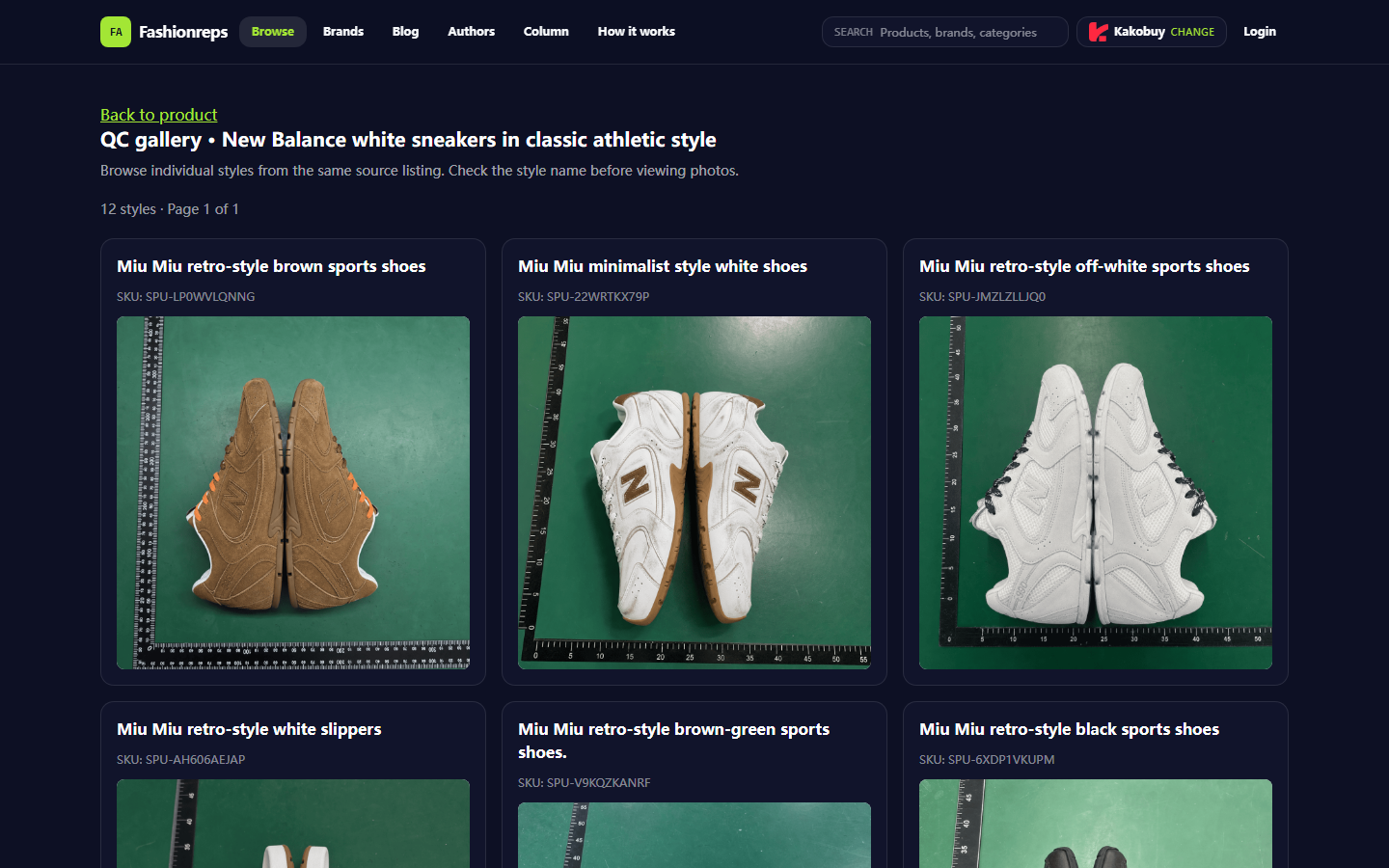
Page records also show that the product page can access a QC gallery and provides multiple style entries from the same source list. This structure is important: when entering the gallery, you cannot just look at image similarity; you must first confirm whether the style name or SKU in the gallery corresponds to the variant you are preparing to purchase.
Follow this order when verifying:
- Copy the complete style name displayed on the page, not just New Balance and color.
- Record the color combination, for example, the main colors of the upper, sole, and logo areas.
- Record the SKU or variant identifier within the page; if none, keep a screenshot or saved page record of the product page.
- Open the size selection area and confirm whether sizes are US, EU, UK, or seller-defined.
- Enter the QC photo portal from the product page and confirm that the image title, style name, or SKU matches the current variant.
- Put the product page, size chart, and QC photos in the same record, and do not use another style's gallery to fill in missing evidence.
If the QC gallery shows multiple styles, the most common mistake is to directly use images after seeing the same brand or similar silhouette. A safer approach is to complete variant matching first, then check details. 🔎
Establish specification and QC evidence records for the same shoe on other platforms
When comparing with other platforms, use the same set of fields, rather than comparing page counts, visual styles, or marketing copy. Other platforms are only suitable as specification references if they can provide identifiable model, variant, and sizing basis.
It is recommended to create the following record for each platform:
| Verification Field | fashion-reps Page | Other Platform Page | Judgment Method |
|---|---|---|---|
| Style Name | Record original page text | Record original page text | If names differ, continue checking model; do not directly treat as same style |
| Color and Variant | Record current variant | Record current variant | Separate if color, sole, or logo differs |
| Size System | Record page labeling | Record page labeling | US, EU, and foot length cannot be directly mixed |
| Size Chart | Save original values and units | Save original values and units | Prioritize comparing foot length and inner length descriptions, not just numbers |
| QC Portal | Check if it corresponds to current style | Check if it corresponds to current style | Mark as missing if no corresponding images |
| Fulfillment Information | Product discovery and agent redirect | Based on platform's current rules | Do not treat product page info as shipping or after-sales promise |
In the table, "other platform" should not be defaulted as more accurate. It can only provide cross-reference when model, color, and size system can be aligned. If another page only has similar product images without clear model or size chart, it can only be recorded as a clue and cannot be used to prove the sizing or QC status of the current product.
Compare toe space, size chart, and variant display methods
Toe space is an observable item in purchase judgment, but cannot be judged solely from product images. Photo angle, lace tightness, shooting distance, and foot model will all change the visual effect. When verifying pages, prioritize looking for the following evidence:
- Are there foot length or inner length values
- Are size chart units clear
- Does the same size use different size systems on different pages
- Is width information listed separately
- Are there narrow, standard, or wide variants
- Does the seller require buyers to provide foot length instead of just selecting their usual size
If the page only has short phrases like "true to size" or "suggest sizing up," do not treat it as a conclusion applicable to all foot types. It lacks applicable conditions and cannot replace actual measurement.
A more reviewable approach is to measure the longest part of both feet, record the difference between left and right feet, and then compare the centimeter measurements with the page's size chart item by item. If the page shows both foot length and shoe inner length, still confirm whether the definitions are consistent, because foot length is not the available space inside the shoe, and inner length does not necessarily represent the effective length of the insole.
For fall/winter shoes, also record whether you will wear thick socks, whether you need insoles, and whether the upper has a stiff edge. They affect the required space, but these factors are personal use conditions and cannot be directly proven by product page images. 🧦
Compare QC photo portals, visible details, and information gaps
The value of QC photos lies in providing visible evidence that can be checked before ordering, not in scoring the product. When checking, observe at least:
- Are left and right shoe shapes roughly symmetrical
- Are seams at toe, heel, and midsole continuous
- Do logo position, font, and orientation match the page style
- Does the sole pattern match the current variant
- Are there obvious stains, creases, glue separation, or color differences on the upper
- Are images sufficient to see key areas
These observations can only describe what is visible in the photos. You cannot assert material grade, wearing comfort, authenticity, or long-term durability from images. If images are too few, angles repeat, or only show shoe boxes and distant views, mark the evidence level as insufficient rather than filling gaps with subjective impressions.
The QC gallery in the fashion-reps page record requires special attention to style attribution. The page may list multiple shoes from the same source, even entries that do not match the current product name. Seeing "QC photos available" does not mean "this particular shoe already has corresponding QC evidence." Before confirming, at least check the style name, SKU, or identifiable variant features.
Other platforms should adopt the same standards. If one platform provides clear images that do not correspond to the current variant, and another provides images for the variant but incomplete, you cannot simply say the former is better quality; the correct conclusion is that the two sides solve different information problems.
Distinguish page specifications, community clues, and editorial inferences
To avoid writing uncertain information as facts, evidence can be divided into three layers:
The first layer is page specifications, including product name, variant, size chart, image portal labeled on the page, and currently visible fulfillment instructions. These can be quoted from the page, but must be re-verified before publication.
The second layer is community clues, such as repeated sizing feedback in discussions, wearing experiences of different foot types, or descriptions of a certain model's toe space. Unless you can fully read the discussion and confirm the context, you cannot treat a single comment as a general rule. Discussions that are deleted, collapsed, restricted, or cannot be fully read can only be marked as partially read and cannot be claimed to represent the entire community.
The third layer is editorial inferences, such as "this style may be more suitable for leaving thick sock space" or "images are insufficient to confirm toe structure." Inferences must be clearly written as judgments and state which visible conditions they are based on, and cannot be disguised as seller promises or actual test conclusions.
The following labels can be used in records:
- Verified: directly displayed on the page, and style and variant match
- Pending recheck: information exists, but may change due to page updates
- Clue only: from community or similar models, cannot be directly applied
- Information missing: page lacks sufficient evidence
- Not applicable: evidence belongs to another style, another size system, or another regional condition
This classification is more useful than giving a product a simple "good" or "bad" because it directly tells you what information to supplement next. 📋
Verification boundaries for wide/narrow feet and return risks
People with wide feet, narrow feet, high insteps, or different left and right foot lengths should not order based solely on brand name or usual size. Page verification must at least confirm three conditions: size system, foot length value, and width information. If width information is missing, the risk of wide/narrow foot fit must be kept as an unresolved issue.
Also distinguish between "wrong size choice" and "insufficient product page evidence." If the page size chart is clear, variant matches, and the buyer still chooses an inappropriate size, the return responsibility may differ from insufficient page information. Specific responsibility must be based on the return conditions applicable to the current seller, agent, and destination country, and cannot be derived from QC photos.
Before ordering, save:
- Product page and variant selection records
- Current size chart and units
- QC photo portal and corresponding style name
- External agent's price, shipping, taxes, and return instructions
- Foot length or notes you submitted to the agent
Do not publicly share complete order numbers, passports, payment cards, addresses, or unmasked shipping labels. If you need to consult others, first mask personal information and keep only the partial content needed to judge the shoe and size.
Final review actions before completing New Balance shoe selection
Before final selection, you can complete a short review in the following order:
- Confirm whether the two pages are really the same model, not similar silhouettes.
- Confirm color and variant consistency, especially sole, logo, and upper combination.
- Put foot length, size system, and page size chart in the same record for comparison.
- Confirm whether QC photos belong to the current style, not other entries from the same source.
- Record visible issues in images separately from content that cannot be confirmed.
- Re-check price, stock, shipping, taxes, return window, and destination country restrictions on the agent page.
- If key fields are still missing, request corresponding information from the seller or agent; do not substitute experience from similar models.
This method saves not a fixed amount, but reduces repeated shipping, return costs, and time loss caused by wrong size, wrong variant, or misunderstanding QC photos. It may also increase pre-order recording time and cannot eliminate risks such as seller shipping wrong items, images not matching actual products, or difficult returns in the destination country.
It is more suitable for buyers willing to measure foot length, save page evidence, and verify item by item before payment; it is not for those who want to order quickly based only on brand name, a single image, or a phrase like "true to size." If the page lacks sufficient model, size, and corresponding QC evidence, postponing purchase is usually safer than forcing a size choice.
Community feedback
0 approved
- No approved comments yet.