New Balance Bundle Cost Checks
Inside this note
If you're planning to pick multiple New Balance items from the fashion-reps catalog and then decide whether to combine or split packages, the easiest mistake isn't the item prices—it's mixing item prices, service fees, payment costs, packaging methods, chargeable weight, destination fees, and exchange rates into a single "looks cheap" number. This guide solves one specific task: before submitting an order or choosing a combining plan, create a review
If you're planning to pick multiple New Balance items from the fashion-reps catalog and then decide whether to combine or split packages, the easiest mistake isn't the item prices—it's mixing item prices, service fees, payment costs, packaging methods, chargeable weight, destination fees, and exchange rates into a single "looks cheap" number. This guide solves one specific task: before submitting an order or choosing a combining plan, create a reviewable cost evidence table and pause when key information is missing. 🧾
This article is for buyers who have already found multiple New Balance items and are preparing to compare the costs of combining versus splitting packages. It's not suitable for confirming real-time inventory, final shipping costs, taxes, or any agent's lowest price, because that information must be based on the real-time quotes from the chosen agent and destination page.

Clarify the Cost Decision for Combining Multiple New Balance Orders
Combining packages doesn't always save money. It might reduce duplicate base charges or some handling costs, but it could also increase the risk of a single loss due to changes in total weight, volumetric weight, package value, or route conditions. Splitting packages usually increases fixed costs, but it may make risk easier to control when route restrictions, package dimensions, declaration requirements, or individual item value are higher.
Before submitting a plan, first write the questions in a calculable form:
- After combining, how much will you pay in total for item prices, service fees, payment costs, packaging fees, and international shipping?
- If split into two or more packages, which fixed fees are duplicated?
- Will combining trigger higher chargeable weight or volumetric weight?
- Do destination taxes, import restrictions, and customs documentation still apply?
- If a package is delayed, lost, or causes an after-sales dispute, will combining expand the single loss?
Only when these questions have verifiable input values can you write "savings" as a calculation result. Without final weighing or official shipping quotes, you can only make plan comparisons, not guarantee savings amounts.
Confirm Each Item and Visible Specs from the fashionreps Catalog
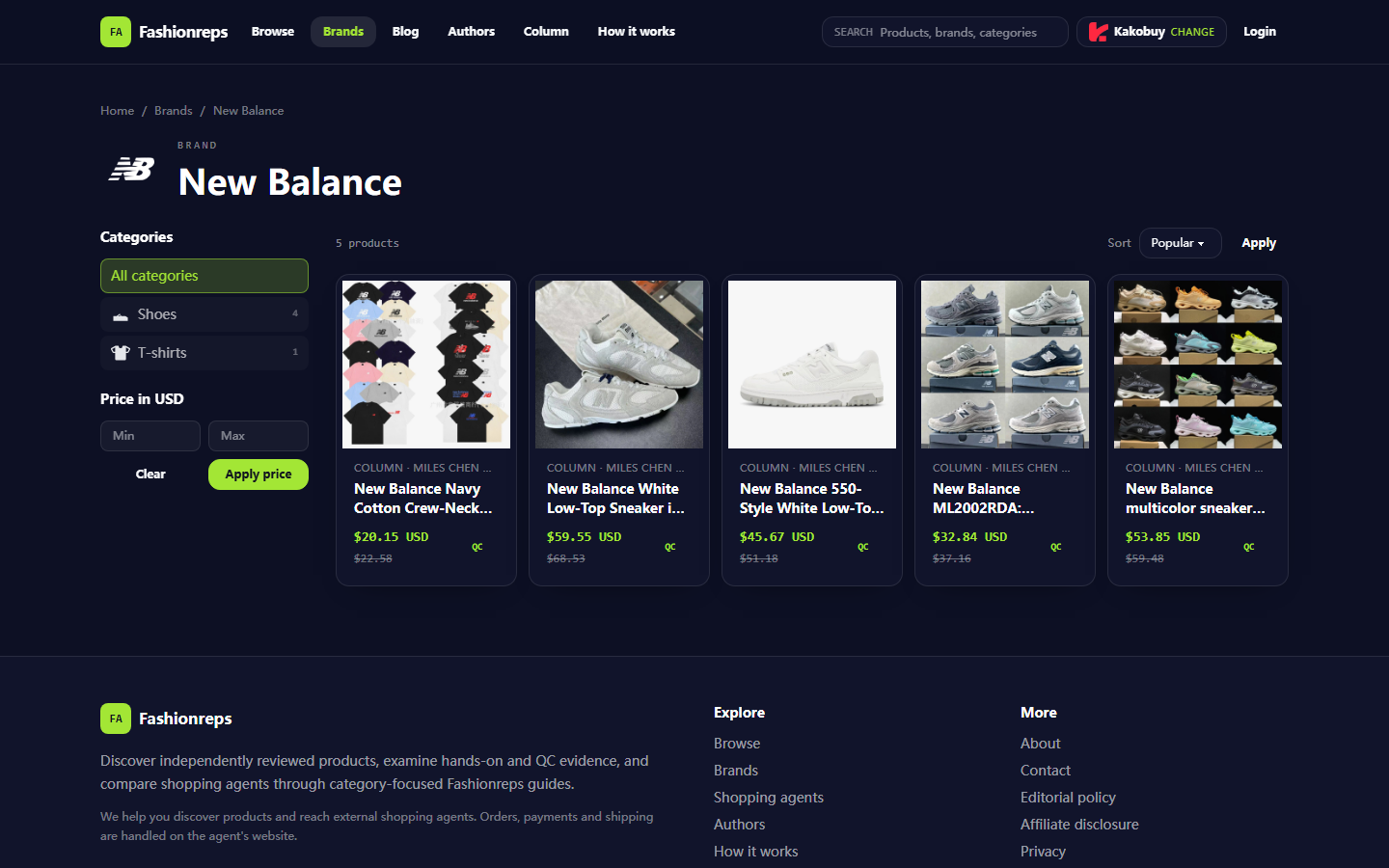
The provided New Balance brand catalog information shows 5 product entries, with page categories of 4 shoes and 1 T-shirt. The catalog shows product names and reference prices, but these reference prices should not be treated as final settlement prices, inventory status, or international shipping costs.
The visible items and reference prices on the page are as follows:
| Item | Visible Page Information | Reference Price |
|---|---|---|
| New Balance Navy Cotton Crew-Neck Graphic Tee | 280g, relaxed fit, direct print lettering | 20.15 USD |
| New Balance White Low-Top Sneaker in a Leather and Sheepskin Trainer Build | Low-top, leather and sheepskin upper description | 59.55 USD |
| New Balance 550-Style White Low-Top Sneakers in Eight Colorways | 550 style, white low-top, 8 colorways | 45.67 USD |
| New Balance ML2002RDA | Multicolor 2002R, pigskin suede, mesh, T-Beam support description | 32.84 USD |
| New Balance multicolor sneakers collection | Mesh and PU casual shoes, 3–5 cm internal height increase description | 53.85 USD |
When recording, also keep the previous reference price shown on the page, but don't treat it as a discount already obtained. The corresponding old reference prices in the catalog are 22.58 USD, 68.53 USD, 51.18 USD, 37.16 USD, and 59.48 USD. They only show that the page displays historical or comparison prices, and cannot prove that the current order will be discounted by the difference.
For each item, at least save the following evidence: item name, item page or catalog location, reference price, visible specs, size or colorway options, page verification date, and whether the corresponding item is still visible after entering the agent. If the page redirects, item names are inconsistent, specs are empty, or item identity cannot be confirmed, stop the combining calculation.
Record Item Prices, Service Fees, Payment Costs, and Current Exchange Rate
First record each cost separately, don't convert into a total at the beginning. This way you can identify where changes come from and avoid mistaking reference prices for final payment prices.
The item section at least includes:
- The page reference price or agent page item price for each item
- Selected size, colorway, and quantity
- Whether the page shows a discount, and the discount conditions
- Whether the item needs to wait for restocking or manual confirmation
The service and payment section at least includes:
- Agent service fee or handling fee
- Payment channel fees
- Fees for recharging, withdrawing, or currency exchange
- Packaging, reinforcement, shoebox removal, or other warehouse service fees
- Possible separate storage, return, or repacking fees
Currency conversion must clearly state the currency, exchange rate source, and verification time. For example, USD reference prices can only be used for initial comparison of item prices; if the final payment uses another currency, use the actual exchange rate shown on the payment page or by the payment institution, and list the exchange rate difference separately. Don't use an undated search result or mental exchange rate to confirm final costs. 💱
The recommended calculation order is: first total item prices, then add service and payment costs, and finally add packaging and international shipping quotes. Tax and customs related amounts, if not supported by destination country and official conditions, should be marked as "to be confirmed", not filled as zero.
Verify Packaging Method, Chargeable Weight, and Destination Conditions
Shoes and clothing cannot be judged for shipping costs solely by item quantity. Whether shoeboxes are kept, packaging is reinforced, and multiple items are placed in the same package will affect actual weight or volume. Especially for shoes, the actual charge may take the higher of actual weight and volumetric weight, and the specific rules must be based on the chosen agent and route quote page.
Before combining, confirm item by item:
- Whether shoeboxes, tags, and original packaging are kept
- Whether unnecessary packaging can be removed
- What is the actual weight of the combined package
- Whether the route uses actual weight or volumetric weight, or takes the higher of the two
- Whether package dimensions will trigger volumetric weight
- Whether the destination accepts the item category and quantity
- Whether declaration information, import restrictions, and tax conditions apply
- Whether insurance or compensation rules are calculated per individual package
Do not use the item quantity in the catalog to infer shipping costs without warehouse weighing, dimensions, or official estimation rules. The 280g visible in the catalog is only for the T-shirt description and cannot represent the weight of the entire order, nor infer the packaged weight of shoe items.
Compare Official Cost Evidence for Combining vs. Splitting Packages
When comparing combining and splitting packages, prepare at least two plans. Each plan should use the same item list, the same destination, the same declaration assumptions, and the same currency, otherwise the difference is meaningless.
For the combining plan, you need to confirm:
- Warehouse weight and dimensions for one package
- One-time packaging or handling fee
- Base, additional weight, or volumetric weight rules for the corresponding route
- Package value and compensation cap
- Destination taxes and customs requirements
For the splitting plan, you need to confirm:
- Weight and dimensions for each package
- Whether each package duplicates handling fees, base charges, or payment costs
- Whether the routes and restrictions for each package are the same
- How to handle separate delays or losses of multiple packages
- Whether additional declaration or customs documentation requirements will arise
Only when combining and splitting both have comparable official quotes can you calculate the difference:
Combining total cost − Splitting total cost = Plan difference
If the result is positive, combining is more expensive under current input conditions; if negative, combining is cheaper under current input conditions. This result only applies to the recorded items, destination, packaging, and quote time, and cannot be generalized to other orders.
Distinguish Page Facts, Calculation Results, and Savings Inferences
When writing records, separate three types of content:
Page facts are directly displayed content from the catalog or agent page, such as 5 New Balance items, 4 shoe entries, 1 T-shirt entry, and the reference price for each item.
Calculation results are content derived from recorded numbers, such as total item prices, cost differences between two plans, or conversion results at different exchange rates.
Savings inferences are judgments based on conditions, for example, combining may reduce duplicate base charges, but actual savings are only possible if the chargeable weight after combining has not significantly increased, packaging fees have not increased, and route conditions are the same.
Do not write "page shows old reference price" as a discount already obtained, do not write "combining may reduce fixed costs" as certain savings, and do not write items without real-time inventory and final quotes as immediately purchasable.
Stop and Supplement Rules When Costs or Packaging Conditions Are Missing
If any of the following occurs, pause submitting the combining plan:
- The item page only has a name, without enough info to confirm specs
- The agent page cannot confirm the item, size, or colorway
- No actual warehouse weight or valid billing rules
- Only actual weight is known, but not whether volumetric weight applies
- Destination, currency, or route is not clearly recorded
- Service fees, payment fees, or packaging fees have no stated applicable conditions
- Taxes, customs, or import restrictions are directly treated as zero
- Combining and splitting plans use different item lists or different quote times
- Page price is a reference price, but settlement price is not confirmed
When supplementing evidence, prioritize obtaining item pages, agent fee pages, warehouse weighing records, route quote pages, and destination rules. Screenshots should cover order numbers, addresses, phone numbers, payment info, and other personal data. For numbers that cannot be verified, leave blank and mark as to be confirmed, do not fill with estimates.
Pre-Submission Cost Confirmation Checklist for New Balance Orders
Before submitting, you can review in the following order:
- Each item's name, size, colorway, and quantity are confirmed.
- Reference prices and actual settlement prices are recorded separately.
- Item prices, service fees, payment costs, and exchange rates are recorded separately.
- Packaging method, shoebox handling, and reinforcement requirements are confirmed.
- Combining and splitting plans both have cost inputs under the same conditions.
- Actual weight, volumetric weight, and route billing rules are confirmed.
- Destination, currency, taxes, and customs conditions are written down.
- Risk is not judged solely by total price, but also considers single loss, route restrictions, and after-sales handling.
- All key numbers have sources, verification dates, and applicable conditions.
- Items lacking official evidence are not written as confirmed results.
Next Steps to Save Evidence and Recheck Real-Time Pages
Put the current catalog data, agent quotes, warehouse weighing, and final payment page into the same order record, and save page names, verification dates, currencies, and screenshot descriptions. If pages update item prices, service fees, packaging conditions, or route quotes, recalculate and do not reuse old differences.
The current data can only support a preliminary cost check for the 5 New Balance catalog items and cannot confirm real-time inventory, final shipping costs, taxes, or any agent's lowest price. The most prudent decision now is: first obtain warehouse weights, packaging options, and destination route quotes for the selected items, then calculate both combining and splitting simultaneously.
When drawing conclusions, clearly state four things: the estimated savings or increase in amount, what risks are added, which type of buyer the plan suits, and under what conditions it is not recommended. If combining only reduces duplicate fixed costs but significantly increases volumetric weight, single loss, or route restriction risks, you should not choose combining based solely on superficial differences.
Community feedback
5 approved
Reader score 4.2 / 5 (5 ratings)