Dior Hoodie Size Guide Before Ordering
Inside this note
What This Verification Guide Solves When buying Dior fall/winter hoodies or knit tops, the most common mistake isn't the brand name—it's confusing the size labels, garment measurements, and body measurements shown on product pages. This article is for shoppers who have found a Dior item and are ready to place an order, but haven't confirmed the fit and sizing yet. After reading, you should be able to do three things: record the size information from the pro
What This Verification Guide Solves
When buying Dior fall/winter hoodies or knit tops, the most common mistake isn't the brand name—it's confusing the size labels, garment measurements, and body measurements shown on product pages. This article is for shoppers who have found a Dior item and are ready to place an order, but haven't confirmed the fit and sizing yet.
After reading, you should be able to do three things: record the size information from the product page, judge the movement allowance needed for fall/winter layering, and pause the order if the measurement chart is missing or inconsistent. This article does not apply to orders where you already have complete physical measurements and only need help with logistics or after-sales issues.
This article is based on the product names, fit descriptions, reference prices, and QC section status currently visible on the Fashionreps Dior category page. The page does not provide complete size charts that would support precise recommendations for each item, so this article will not invent chest, length, or sleeve measurements for you. Highly volatile information should be rechecked before ordering; the verification date is October 16, 2026. 🧭

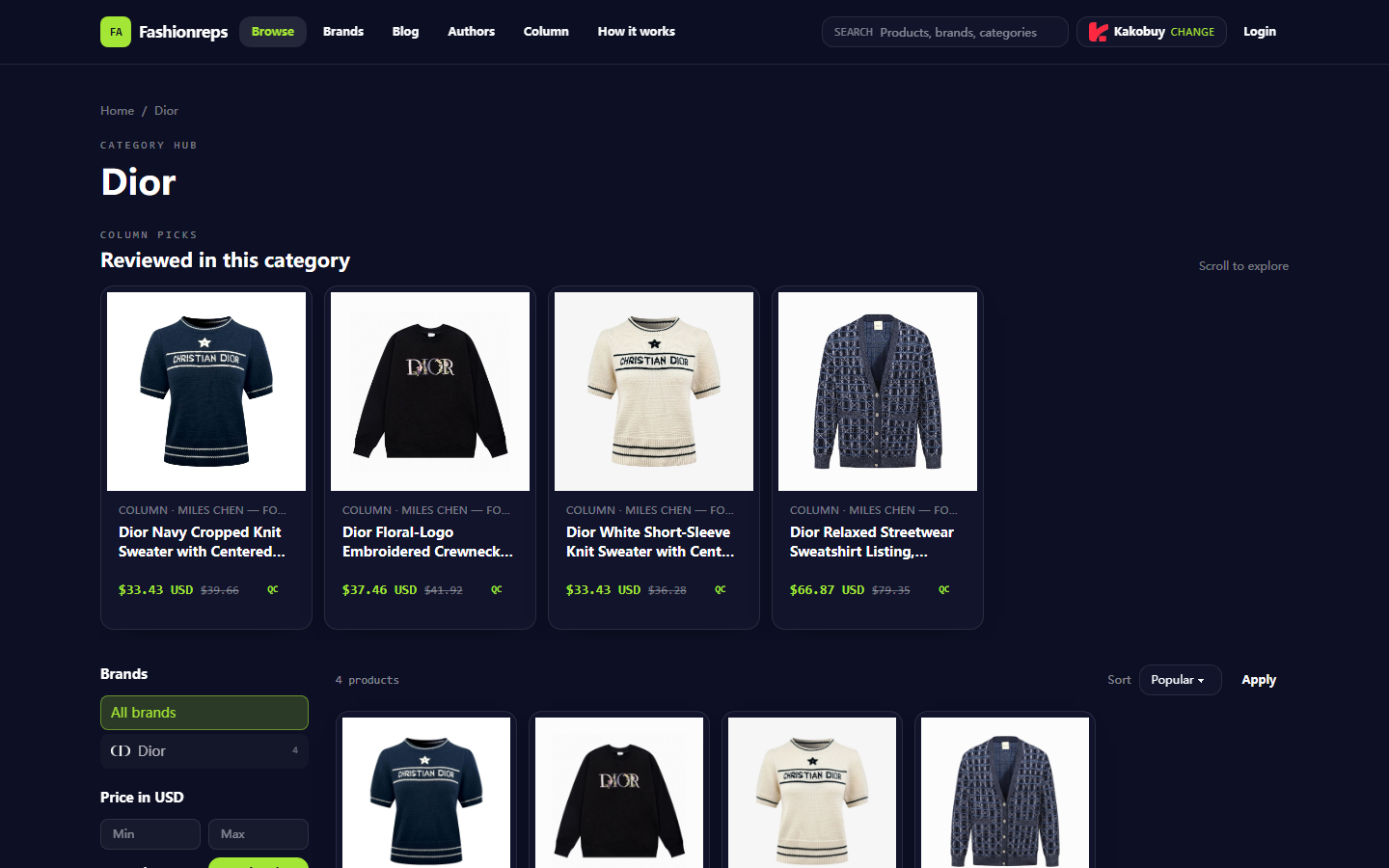
Image: The product catalog and filter interface on the Fashionreps Dior category page. The image is for illustrating the page information structure only and does not represent the actual sizing or fit of any single item.
What Size Information to Record on Dior Product Pages
Open the specific product page first, not just the category page. The category page currently shows 4 Dior items, with descriptions like cropped knit sweater, embroidered crewneck sweatshirt, short-sleeve knit sweater, and relaxed streetwear sweatshirt. Their fits, fabric thickness, and suitable styling are not the same—you cannot use one set of size judgments for all of them just because they all carry the Dior name.
Record the following items one by one:
- The complete product name and style description shown on the page
- Available sizes, including whether they use numeric, letter, or mixed sizing labels
- Garment measurements like chest, shoulder width, length, and sleeve length
- Measurement method, such as flat lay, along outer side, or including ribbed parts
- Allowed tolerance, and whether the page states the measurement unit
- Fit keywords, such as cropped, relaxed, crewneck, or knit
- Whether page images show front, back, collar, and cuff details
- Whether the QC section has viewable product photos or measurement evidence
- Reference price and its display date
The reference prices on the category page should only be used as clues during filtering. The four reference prices currently shown on the page are approximately $33.43, $37.46, $33.43, and $66.87, along with previous reference prices. They are not the final product prices, and do not include possible service fees, international shipping, taxes, or after-sales costs. 💰
| Page Information | What It Can Help Judge | What It Cannot Directly Support |
|---|---|---|
| Descriptions like cropped, relaxed, crewneck | Initial judgment of fit direction and layering needs | Cannot directly derive specific chest or length measurements |
| Available sizes | Determine if the desired size is listed | Cannot prove the size will fit your body measurements |
| Flat lay measurement chart | Compare to actual measurements of your existing clothes | Cannot replace verifying measurement method and tolerance |
| QC photos or measurement records | Check for visible evidence | Cannot turn photo observations into conclusions about personal touch or try-on |
| Reference price | Initial budget filtering | Cannot be treated as final payment amount or stock guarantee |
How to Distinguish Garment Measurements from Body Measurements
Body measurements are the data you get from measuring yourself; garment measurements are the data of the clothes laid flat or measured as specified on the page. They are not the same numbers. For example, a garment's chest measurement usually needs to allow extra room beyond your body chest measurement; if you plan to layer a base layer, shirt, or thin jacket, the needed allowance increases further.
The safest approach is to find a top you already wear comfortably, with a similar thickness to the target item. Lay it flat, keep the body naturally smooth without stretching the knit fabric, and record the following:
- Width from armpit to armpit
- Width from shoulder seam to shoulder seam; if there is no clear shoulder seam, record the structure near the armhole
- Length from the center back neck point to the hem
- Sleeve length from shoulder seam to cuff; for drop-shoulder styles, record the measurement method specified on the page
- Hem width and cuff width, especially for knit or ribbed styles
If the page gives a flat chest width, and your reference garment records a full chest circumference, don't compare them directly. First confirm the measurement basis, then convert if needed. If the flat chest width is 58 cm, simply multiplying by 2 gives an estimated flat perimeter of about 116 cm, but this can still be affected by fit, curved seams, elasticity, and measurement position, so it should not be treated as a precise actual measurement.
For knit fabrics, pay special attention to elasticity. If the page does not state the fabric composition, knit structure, or elasticity range, don't assume that "knit" means it will naturally stretch or shrink. Record the information gap and request actual measurements for the corresponding size from the seller or purchasing agent. 🧵
How to Judge Allowance for Fall/Winter Layering
For fall/winter sizing, first determine the wearing method, then look at the numbers. You can categorize the target wearing style into three types: wearing alone, wearing over a thin inner layer, or layering an outer jacket over the hoodie. Different styles have different requirements for chest width, shoulder mobility, sleeve length, and garment length.
If the item is a cropped fit, length is key. Even if the chest is ample, a short length may expose the inner layer when raising your arms or layering. If the page describes it as relaxed, the shoulders and body width may be wider, but you still need to check actual measurements—don't automatically assume "relaxed" means every part is larger.
For a crewneck sweatshirt, check the collar and shoulder mobility first. When wearing thicker inner layers in fall/winter, whether the collar presses and whether the shoulders restrict arm movement can be more important than simply comparing garment length. For knit items, also check whether the cuffs and hem have significant ribbing or tightening, so you don't focus only on chest width and ignore the overall proportion after wearing.
Judge in this order:
- First determine the thickness of the innermost layer you'll wear most often.
- Find the garment measurements of an existing top that fits you well.
- Compare with the measurement items on the product page that use the same basis.
- Judge shoulder width, sleeve length, and garment length separately, not just chest circumference.
- Allow a safety margin for knit elasticity, measurement error, and post-wash changes.
- If the page does not specify the measurement method, mark the conclusion as pending confirmation.
Don't treat "buy one size up" as a universal solution. A larger size may increase chest width, but it can also cause sleeve length too long, shoulder seams dropping, disproportionate length, or a loose collar. A better decision is to first identify which specific size information you are truly missing. 📏
How to Keep Evidence When Page Information Is Incomplete
Size judgment requires traceable records. Save screenshots or text records of the product page before ordering, but be careful not to expose order numbers, shipping addresses, phone numbers, payment information, or complete shipping labels. Screenshots should retain the product name, size options, measurement chart, page date, and relevant notes, while covering personal information.
Create a brief verification record:
- Product name: Copy the complete page name, do not abbreviate it yourself
- Page URL: Saved by the system, do not manually add links in the text
- Verification date: Record the date you viewed it
- Page sizes: Copy each item, keep original units
- Measurement basis: Note flat lay, circumference, or other method
- Reference garment: Brand can be omitted, but write down the style and thickness
- Main differences: List differences in chest width, shoulder width, length, and sleeve length
- Pending questions: Only write questions that the seller or purchasing agent can answer
- Evidence status: Distinguish between page visible information, QC photos, and unconfirmed information
If the product page only has the name and reference price, without a size chart, do not substitute measurements from other Dior items on the category page. Different styles, even with similar prices, can have different fits and measurements. If the page only has blurry images, do not infer specific sizes from the model's body or image proportions.
This article is compiled from editorial materials based on page-visible information and verification methods; it does not claim to have personally purchased, received, worn, or tested any product. Factual fields should be re-read and confirmed on the page before publishing or ordering. 🔎
Pre-Order Size Check Checklist
Before submitting the order, confirm each item:
- [] I recorded information from the specific product page, not just the category page
- [] I know the unit and measurement method used for the page sizes
- [] I have a well-fitting top of similar thickness as a reference
- [] I compared chest width, shoulder width, length, and sleeve length separately
- [] I considered fall/winter inner layers, not just wearing alone
- [] I confirmed the meaning of fit descriptions like cropped or relaxed
- [] I did not treat the reference price as the final payment amount
- [] I kept the verification date and evidence screenshots
- [] Screenshots covered address, phone number, order number, and payment info
- [] Missing data on the page has been listed as pending items
If you plan to order through a purchasing agent, resolve sizing questions before submitting the order. The purchasing agent handles order, payment, and delivery, but cannot infer missing product measurements for you. If you discover inconsistent measurement basis after ordering, you may be limited by return windows, international shipping costs, and item condition.
When to Pause Purchase and Consult
If any of the following occurs, pause the order:
- The product page has no clear size chart, and size descriptions on different pages contradict each other
- The page only has model photos, no garment measurements or verifiable measurement records
- The size you need is not in the current available options
- The item is clearly cropped or loose-fitting, but the page lacks length, shoulder, or sleeve information
- Knit items do not state fabric composition, elasticity, or measurement tolerance
- The seller only responds "buy your usual size" without providing specific measurements
- QC photos cannot confirm the product name, size label, or key dimensions
- The page price, stock, or purchase entry status is inconsistent with the current page
When consulting, ask questions that can get clear answers, such as "Please provide flat lay chest width, length, shoulder width, and sleeve length for size M in centimeters, and state the measurement tolerance." Don't just ask "Will this fit?" because that question lacks verifiable size conditions.
Final Next Steps
Now open the target product page, copy the complete name, record the size chart and verification date, then compare with a well-fitting top of similar thickness. If the page provides measured data on the same basis, decide item by item based on chest width, shoulder width, length, and sleeve length; if you can only see the name, reference price, or model photos, hold your questions and do not substitute data from other Dior items.
What you save is not a fixed amount of money, but the cost of returns, reshipments, and repeated international delivery due to size errors; the trade-off is spending extra time measuring and consulting before ordering. This is suitable for buyers who value fit, fall/winter layering, and evidence retention; not suitable for those who only want speed, can't wait for the seller to provide measurements, or have confirmed the item cannot be returned or exchanged.
Community feedback
0 approved
- No approved comments yet.