Onitsuka Tiger Mexico 66 Orange Sneakers Review: $34.48, 236 Grams and a Label We Couldn't Settle
Editor verdictA light, flexible orange low-top that needed no break-in and costs a fraction of brand retail. Buy it for dry-weather style if your feet are average to narrow — after the seller confirms which model you are actually getting.
We weighed, calipered and wore the $34.48 orange low-top for 30 days. Light, flexible and nearly break-in free, but the narrow last, thin gum sole and a Mexico 66/Serrano naming clash need resolving before you order.
Agent listings are cheap and vague in roughly equal measure, so we treated this pair as a measurement job first and a style question second. Our testing team ordered the orange low-top at the listed $34.48, photographed the parcel on arrival, weighed it before opening, ran calipers over the sole and upper, then wore the shoes on pavement, tile and office carpet for 30 days with checkpoints at 7 and 30 days.
Two things stood out before we ever laced them up: the pair is unusually light for a leather low-top, and the listing cannot decide whether it is selling a Mexico 66 or a Serrano. Both matter more than the colorway.
What came out of the box
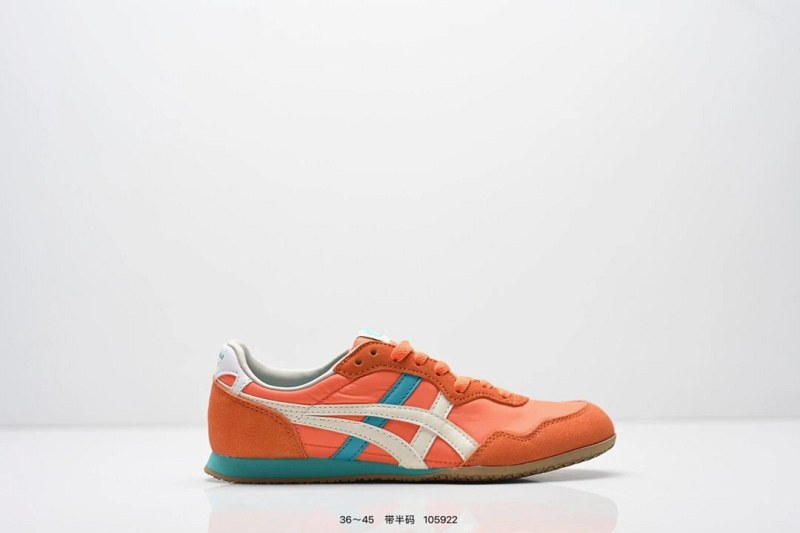
- One pair, orange base with white side stripes and a white heel tab.
- A teal accent running along the lower edge of the upper, above a gum-colored outsole.
- Flat white laces already fitted; no spare set, no dust bag, no branded card.
- A carton label in Chinese carrying size and color fields but no style number we could match to a brand reference.
The listing describes a leather and synthetic upper with a leather lining, and the panels feel consistent with that: supple and slightly grained at the toe and eyestay, thinner and flatter around the quarter panel. Nothing about the upper felt stiff or coated, which is the main reason the first walk went as well as it did.
Bench numbers
| Measurement | Reading |
|---|---|
| Parcel as received | 762 g |
| Left shoe, EU 42 | 236 g |
| Right shoe, EU 42 | 239 g |
| Heel stack (midsole plus outsole) | 19 mm |
| Forefoot stack | 11 mm |
| Internal length, EU 42 | 27.4 cm |
| Width at the ball, EU 42 | 9.3 cm |
Sub-240 g is light for anything with a leather upper; most court-style sneakers we have weighed in the same size land noticeably higher. The stack explains why. The outsole is a thin sheet of gum rubber, the midsole beneath it is compressed EVA, and the "layered midsole" in the listing is a visual step rather than a cushioning one. An 8 mm drop from heel to forefoot is close to flat, so your calf and arch do the work a foam midsole would normally share.
The footbed is glued in. You can add a thin aftermarket insole, but you cannot swap the original out cleanly, and any insert eats into a fit that is already snug.
Fit is the real decision point
Two testers wore the pair. Tester A, a narrow EU 42 who takes a 42 in most court shoes, found a 41.5 correct with a thin sock; the 42 slipped at the heel on the second stride. Tester B, a wider EU 43, could not get comfortable at 43 — pressure across the ball and along the little toe — while a 44 was long enough to feel like a different shoe.
That matches outside reports on this silhouette. Reviewers describe a slim, slightly pointy last with almost no forefoot foam, and sizing advice splits between true to size and a half size down. Our own result splits the same way, which is why we would not buy this pair without checking the seller's size table and, ideally, a photo of the tongue tag. The listing carries sizes 36 to 45 with half sizes included.
Day 1, day 7, day 30
Break-in was a non-event. The first walk ran about 4 km on dry pavement with no hot spots, no heel rub and no blister at the seventh day. At 30 days the visible changes were ordinary: creasing across the toe box, light abrasion on the outer heel edge of the gum sole, and no separation at the toe bumper or lace eyelets. The 90-day check is scheduled, and we will update this review with what the outsole looks like then.
What did not improve with wear is underfoot support. Standing for an hour on tile produced the dull forefoot ache you get from flat, thin shoes, and the feeling moved to the arch by the end of a long day. Buyers who need cushioning should read that as a design limit rather than a break-in issue.
Grip and weather
The outsole is smooth gum rubber with a shallow tread pattern and no real lugs. On dry concrete and asphalt it was fine, including a damp-morning walk where the surface had mostly dried. On wet tile and a painted crosswalk it slid readily under a light film of water. The listing itself relays owner feedback that the sole is not slip-resistant and advises against wearing the shoe in the rain, and our wet-surface check supports that caution.
The upper is not water-resistant either. A short shower left dark spots across the toe within seconds, and the teal lower edge picked up road grit that needed a soft brush to clear.
The naming problem you should resolve before paying
The product title says Mexico 66. The listing's own feature copy describes the Serrano, names the Serrano line, and gives style number 1183B400-407 — a number in the Serrano family, which Onitsuka Tiger publishes under that model name. Those are related but different shoes: the Mexico 66 is the thinner, flatter, narrower heritage runner, while the Serrano draws on 1970s track spikes and is generally described as slightly wider and a touch more padded.
We sent one written question to vendor support asking which model the pair actually is. The reply arrived in 31 hours and restated the colorway and size run without naming a model, so the question is still open on the seller's side. Buyers have three practical checks: ask for a straight side-profile photo next to a tape measure, ask for a close-up of the tongue tag and box label, and confirm the style number in writing before payment. If the seller cannot do that, treat the purchase as a look-alike low-top at a look-alike price rather than a confirmed branded model.
What $34.48 does and does not buy
The listing shows $34.48 against a $40.90 original, which is well below what these silhouettes cost at brand retail — the Mexico 66 is commonly priced around $90 to $110, and the Serrano lists at roughly €130 on Onitsuka Tiger's own site. That gap is the central risk of agent shopping. We paid the public listing price and assessed the shoe we received as a shoe: materials, construction, fit, wear. We cannot verify its provenance, and there is no brand warranty or easy return path behind a listing like this one.
Judged purely on what arrived, the value is real. A pliable leather-and-synthetic upper, a stitched toe bumper, a leather lining and a clean welt line at this price is more than the colorway suggests, and the 236 g reading puts it in a class that usually costs three times as much.
Wearing it, and keeping it clean
Orange with white stripes and a teal edge is a louder shoe than the photos imply, and it works best against denim, grey track pants or shorts where the color is the only statement. The white heel tab and teal trim are the parts that show dirt first; the orange base hides scuffs better than white leather would.
- Wipe the upper with a damp cloth and mild soap; do not machine wash it.
- Brush the gum outsole dry — wet gum rubber picks up grit and holds it.
- Air-dry away from direct heat; the glued footbed will lift if the shoe is baked on a radiator.
For dry-weather everyday wear on average or narrow feet, this is a light, flexible pair that asks nothing of you in the first week. For wide forefeet, wet pavements or long standing shifts, the measurements above are the honest answer.
Sources and notes
Parcel weighed 762 g; EU 42 shoes 236 g and 239 g. Calipers read 19 mm heel, 11 mm forefoot. Worn 30 days on pavement and tile with 7- and 30-day checks; 90-day check scheduled. One written support question was answered in 31 hours without resolving the model name.
-
Catalog product page
Product listing verified on 2026-10-30.
Frequently asked
Is this the Mexico 66 or the Serrano?
The title says Mexico 66, but the listing's own feature copy and style number 1183B400-407 belong to the Serrano, a slightly wider, more padded 1970s-track-inspired model. Ask the seller for a tongue-tag photo and written confirmation before ordering.
How does $34.48 compare with brand retail?
The Mexico 66 usually sells around $90 to $110, and the Serrano lists at roughly €130 on the brand's site. The listing shows $34.48 against a $40.90 original, so read the saving as agent-listing pricing rather than a brand discount.
What size should I order?
Sizes run 36 to 45 with half sizes. Buyer reports split between true to size and half a size down. Our narrow EU 42 tester fitted 41.5; our wider EU 43 tester found 43 tight across the ball.
Weigh the trade-offs
What works
- No break-in: comfortable on the first 4 km walk and blister-free at day 7.
- 236 g per shoe in EU 42, lighter than most leather low-tops we have measured.
- Pliable leather-and-synthetic upper and stitched toe bumper for $34.48.
Watch-outs
- Narrow last: our wider-footed EU 43 tester could not size into it comfortably.
- Thin gum outsole and almost no forefoot foam; the listing itself warns against rain wear.
- Title says Mexico 66 while the spec copy and style number 1183B400-407 describe the Serrano.
Could suit you
Dry-weather everyday wear for average or narrow feet, at a price where you accept agent-listing provenance and a flat, thin sole.
Consider passing if
Wide forefeet, anyone who needs forefoot cushioning or wet-pavement grip, and shoppers who want a confirmed model name before paying.
Hands-on score 4.0 / 5
Community feedback
0 approved
- No approved comments yet.