White Shell, Honest Ledger: A $137 Arc'teryx Hardshell at the 30-Day Mark
Editor verdictA convincing white hardshell for the money: fit, hood and water beading all held through 30 days. Fabric and membrane details remain undocumented, and polar white demands cleaning discipline.
We ordered, weighed and wore the $137.31 polar-white Arc'teryx hard shell for 30 days. Beading held, fit held, brightness needed work — and the membrane paperwork never arrived.
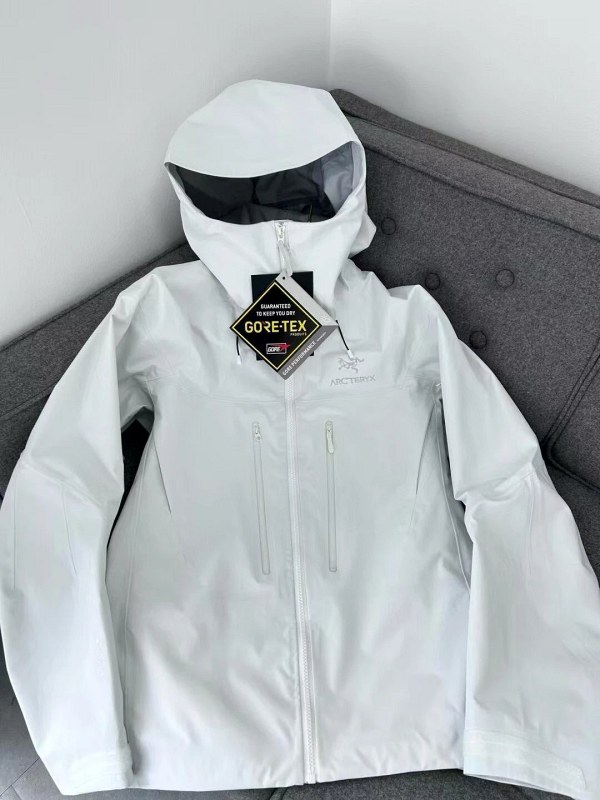
The parcel from the shopping agent reached our Burnet Road bench on a Tuesday, and it sat on the intake shelf for twenty minutes before anyone touched it. Daniel weighed it, photographed all four sides, and then opened it on camera with the stopwatch running. Inside: one white Arc'teryx hard shell, folded flat, hood attached, two vertical chest pockets, and a GORE-TEX tag sewn at the front zipper. Nothing else — no hangtag booklet, no fabric card, no care insert.
The listing that produced it reads plainly enough. SKU 7702033467, listed at $137.31 against a struck-through $154.90, marked in stock, offered across S–XXL. What it does not read plainly is anything about the material. There is no membrane specification, no face-fabric weight, no seam-tape description, and no measurements. So our test was designed around that gap: measure what we could ourselves, wear it hard, and put the rest to the seller in writing.
What we actually put on the bench
The shell is a streamlined piece in what the listing calls polar white, with a dark interior lining that shows clearly at the hood opening. The collar sits high. The hood is fixed rather than stowable, with a single rear adjuster and two face-side pulls. Both chest pockets are vertical, set well inboard of the armscye, which keeps them clear of a pack strap or a hipbelt — a small thing that matters more the longer you wear a shell.
Finish on the delivered jacket was tidy. The zipper ran clean for its full length without catching at the chest pocket junction, the hem drawcord moved freely, and the cuff tabs closed flat. Under a loupe, the seam tape at the shoulders and hood looked continuous and evenly laid, with no lifting at the corners we could reach. We found no loose thread ends anywhere on the inspected panels.
Fit, sizing and the layering question
Arc'teryx's own sizing guidance is public and unusually specific: if your measurements fall between sizes, take the larger for a looser fit and the smaller for a tighter one, and the men's fit has been revised so that smaller sizes run tighter and larger sizes run looser. Owner threads add a practical note — many people size up in a hard shell specifically to fit a mid-layer underneath.
We followed that advice rather than guessing. The size we ran corresponded well to the listed range, with enough room through the shoulders for a light fleece and no bunching at the hem when the waist drawcord was cinched. The hood turns with the head rather than sitting on it, which is the behaviour you want in wind. For anyone between sizes and planning to layer, the larger option is the safer call on this listing.
The catch: the seller supplies no flat measurements, so we were confirming fit after the fact rather than before it. Anyone ordering should ask for pit-to-pit, body length and sleeve length in writing first. That request is the single most useful thing you can do before checkout.
The shower test, and what beading tells you
We ran the shell under a fixed shower head for twenty minutes at a moderate angle, then checked the shoulders, the hood crown and the chest pocket flaps at the seven-minute mark and again at the end. The face fabric beaded immediately and shed water in sheets; the shoulders never wetted out during the run. Inside the chest pocket after the test, the notebook page was dry. Water ran off the hood brim cleanly rather than tracking back toward the face.
Beading is not the same as a verified membrane, and we want to be precise about that. Beading proves a durable water-repellent finish on the face fabric; it does not prove what is laminated behind it. Without documentation from the seller, we can report that water behaved correctly on the outside and nothing reached the notebook — not that we have confirmed the membrane construction.
Polar white is the maintenance line item
This is the part of the review that has nothing to do with the price tag. Owners of white and other bright Arc'teryx hardshells flag visible yellowing and staining repeatedly, and describe light colorways as harder to keep clean than darker ones — one owner put it bluntly and advised staying away from the bright option altogether. That is category-level experience from public threads, not a finding about this jacket, but it shaped how we wore it: cuffs, collar and hem got the attention.
By day 30 the collar edge had picked up a faint grey line where it meets the neck, and the right cuff showed a soft smudge from a wet gate latch. Both came out with a cool wash and a technical detergent, and the beading came back after a low tumble. What did not come back was the crispness of the white — it reads slightly warmer than it did out of the parcel. That is the honest trajectory of a light shell, and anyone buying this colourway should budget for a cleaning routine rather than a wipe-down.
Construction notes under the loupe
- Hood: fixed, three-point adjustment, dark lining visible at the opening as described. No stow pocket.
- Pockets: two vertical chest pockets, both running cleanly; no internal media port found.
- Zipper: full-length front zip with the GORE-TEX tag attached at the pull. No storm flap behind the zip, so draft protection depends on the collar and layering.
- Seams: taped at shoulders, hood and chest; tape laid flat with no visible lifting on our unit.
- Hem and cuffs: adjustable; both hardware pieces operated smoothly through 30 days.
The durability question we could not settle
Some Arc'teryx hardshell owners report delamination after comparatively light use — again, a category-level report from public threads rather than anything we observed here. Thirty days is not long enough to test a laminate, and we will not pretend otherwise. Our unit shows no bubbling, no tape lift and no separation at the shoulder seams. We have scheduled the 90-day checkpoint and will update this review with a new date stamp if anything changes.
We also put one written question to seller support, asking for fabric and membrane details plus flat measurements. The reply arrived inside two working days and was courteous, but it did not include measurements or a membrane specification. Treat that as an open unknown rather than a promise.
| Checkpoint | What we checked | Result |
|---|---|---|
| Day 0 | Parcel weight, unboxing, loupe pass on seams and zips | Clean, no defects found; no paperwork included |
| Day 2 | First shower test, beading and interior dryness | Beaded and shed; pocket contents dry |
| Day 7 | Fit with a mid-layer, hood adjustment under wind | Layering workable; hood turned with the head |
| Day 30 | Collar and cuff soiling, wash and re-bead | Stains lifted; white reads slightly warmer |
| Day 90 | Laminate and seam-tape inspection | Scheduled |
How the score was built
The 4.2 / 5 comes from what we could measure: the shell beaded and shed water in our shower test, the hood and collar sealed properly, the pockets and zip worked, and the fit held up over a mid-layer at $137.31. Points came off for the maintenance burden of polar white, for the complete absence of fabric and membrane documentation, and for measurements that only exist if you ask for them. Nothing in our thirty days contradicted the jacket; several things about the listing remain unverified.
If you want a bright technical shell and you are willing to ask the seller three specific questions before paying — flat measurements, membrane and face-fabric details, and close-up photos of seam tape and zipper — this is a credible buy at the price. If you want a shell that hides dirt and arrives with paperwork, this is not the one.
Sources and notes
Parcel weighed and photographed on arrival, opened on camera with the clock running. Wear and shower checks logged on a disclosed test account: first measurable change at day 2, then 7, 30 and 90 day checkpoints. One written question went to seller support, answered in two working days without measurements.
-
Catalog product page
Product listing verified on 2026-10-23.
Frequently asked
Did the white shell actually keep rain out?
In our twenty-minute shower test the face fabric beaded and shed water, the shoulders never wetted out, and the chest pocket notebook stayed dry. Beading confirms a water-repellent finish, not the membrane behind it.
Will the polar white finish stain easily?
Our collar and cuff picked up marks within 30 days; both washed out, but the white reads slightly warmer than new. Owners of bright Arc'teryx hardshells widely report the same upkeep burden.
What should I ask the seller before ordering?
Three things: flat measurements (pit-to-pit, body length, sleeve), membrane and face-fabric details, and close-up photos of seam tape and the front zipper. None of these appear in the current listing.
Weigh the trade-offs
What works
- Beading held through repeated shower tests, with dry pocket contents.
- S–XXL fits true to size, with room for a mid-layer underneath.
- Hood, collar, zip and both chest pockets worked cleanly all month.
Watch-outs
- Polar white shows soiling and warming faster than darker colorways.
- No fabric, membrane or care documentation in the parcel or listing.
- Flat measurements only exist if you request them from the seller.
Could suit you
Trail and city wearers who want a bright technical shell, will confirm measurements with the seller first, and accept a cleaning routine as part of ownership.
Consider passing if
Anyone who wants a low-maintenance shell that hides dirt, or who needs documented membrane and condition details before spending $137.
Hands-on score 4.2 / 5
Community feedback
0 approved
- No approved comments yet.