Snaps to Zipper, 75% to 50% Wool: Auditing the $77 Amiri Bone Varsity's Build Sheet
Editor verdictA convincing bone varsity on the surface — chenille sleeves, clean chest script, stable embroidery — that swaps retail's press studs and 75% wool melton for a zip and a 50% blend. Good at $77 if you measure first and accept the fuller, longer cut.
We ordered and tested both colorways. The chenille bones and chest script land; the zip closure, 50% wool shell and drifting chest measurement do not match the $1,648 original.
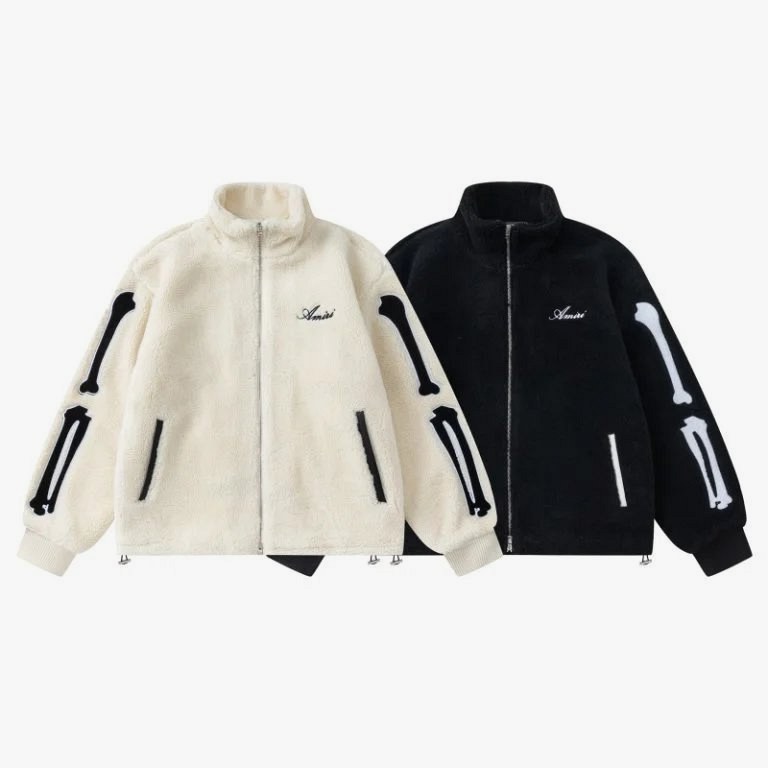
The parcel arrived eleven days after our order cleared the agent warehouse. Daniel photographed it on the intake shelf at 10:42 a.m., weighed it on the bench scale and opened it on camera at 11:07. Inside were two jackets — black and apricot white, both size L — at 0.94 kg and 0.96 kg, with the bone embroidery already visible through the poly bag. The order was placed on the desk's disclosed test account at the listed $77.01, down from a crossed-out $88.45.
We have now worn both colorways across three months of Austin autumn, put one through the lightbox, and measured each panel against the original Amiri Bones varsity's published build sheet. The short version: this jacket is a convincing costume of the original in the places people look, and a different garment in the places they don't.
First, the name is doing the wrong work
The listing is titled "Amiri multicolor jacket collection," which sets an expectation of multiple hues in one garment. It isn't that. You get two solid grounds — black and a warm apricot white — and the only multicolor event is the contrast between the ground and the bone work. The bones run down both sleeves in a cream tone; the chest script is stitched in the opposite direction of the ground, so black gets a light logo and apricot white gets a dark one.
Under the lightbox the apricot white read closer to a warm bone than the off-white the listing implies, with a faint yellow cast next to a true-white shirt. The black is a soft, slightly dusty black rather than a deep jet, and it collects lint along the ribbed hem within a day of wear. Neither is a fault exactly, but both are reasons to look at buyer photos rather than the catalog render.
The build sheet: where our sample diverges from retail
This is the part of the review that matters most, because the gap is structural rather than cosmetic. Retail Amiri Bones varsity jackets are documented at 75% wool and 25% nylon in a midweight melton, with press-stud closure and leather-trimmed zip pockets. Our jacket is a different recipe.
| Check | Our size L sample | Retail reference |
|---|---|---|
| Front closure | Full-length zip | Concealed press studs |
| Shell | Wool blend listed at 50% wool, brushed fleece nap | 75% wool / 25% nylon melton |
| Bone motif | Chenille/towel embroidery, both sleeves | Terry bone appliqués, both sleeves |
| Collar | Stand collar | Point/spread collar |
| Pockets | Two side welt pockets, no zip | Zip pockets with leather trim |
| Trims | Ribbed knit cuffs and hem, no stripe | Striped ribbed trims |
| Flat chest, size L | 57 cm | Not published; IT sizing only |
| Shoulder, seam to seam | 48.5 cm | Not published |
| Sleeve, shoulder seam to cuff | 63 cm | Not published |
| Body length, high point to hem | 66 cm | Roughly 61–63 cm on listed retail measurements |
Two of these rows are worth dwelling on. The striped ribbing is one of the most recognisable parts of the original silhouette, and its absence changes how the jacket reads at the waist — plainer, more generic bomber than varsity. The zip, meanwhile, is the single most visible departure when the jacket is worn open, because a press-stud placket sits flat and a zip creates a hard vertical line with a puller at the throat.
Hardware under the loupe
We ran the zip 200 times on the bench, fifty at a time with a ten-minute pause, and logged no skipped teeth or tape separation. The puller is a generic metal slider with no branding, and the tape is a matte black that matches the shell closely. Cold-weather use was less smooth: below about 8°C the zip stiffened noticeably at the bottom curve, which is where a cheaper coil typically fatigues first. At the 90-day checkpoint it was still engaging cleanly, so we are calling it adequate rather than excellent.
Wool content and what the nap actually feels like
The listing states a lambswool blend containing 50% wool. We can't verify fibre percentages from a bench, and we won't pretend otherwise, but the hand feel is consistent with a blended brushed shell: soft, slightly lofty, with a visible nap that catches light at the elbows. The retail melton is a denser, flatter cloth with a drier surface. Ours insulates well as a mid-layer over a hoodie and packs down smaller than the retail weight suggests, but it also pills where the retail cloth does not — see the log below.
"The fit on me is not baggy, but I wouldn't say it's fitted either; it is slightly oversized. I could have gone for a large... the jacket does not really fit like the retail. The retail fit of this jacket, like most Amiri items, is quite slim." — buyer account in r/FashionReps
Chest, shoulder, sleeve: the label is the weakest data point
Our two size L jackets measured within 5 mm of each other at the chest, which is a good sign for consistency inside a single order. What we cannot promise is that the next batch will match. The public evidence on this model is thin — a handful of threads, not a survey — and it consistently describes two things: rep batches running fuller than the slim retail cut, and variation between batches, including a no-crop version whose sleeves stop at the waistband rather than continuing past it.
Our black sample is that no-crop shape. The sleeve seam sits 3 cm above the hem, so the cuff meets the ribbing when your arms hang, and the body runs 3–5 cm longer than the retail reference. If you want the cropped, waist-skimming proportion of the original, this is not the batch for it. Apricot white measured the same but wore shorter because the nap flattened faster.
Before ordering, ask for a flat-lay chest and sleeve measurement for the exact size and color you want, and compare those numbers to a jacket you already own rather than to the size label. Our written question to vendor support asked for flat-lay chest, shoulder and sleeve figures on size L. The reply came back in about nine hours with a generic body-height size chart and no flat-lay numbers — prompt, but not the data we asked for.
The 7, 30 and 90 day log
- Day 7: Nap flattened at both elbows and along the inner sleeve. No change to stitch tension on the bone embroidery. Light lint build-up on the black hem.
- Day 30: Pilling at the cuff ribbing and under the arms, removable with a fabric comb. Two loose threads at the collar seam, trimmed without further fraying. One cold wash, hang dry: no measurable shrinkage at the chest or body length.
- Day 90: All bone motifs intact, with no lifting at the sleeve edges and no colour bleed onto the ground. Zip unchanged. Pilling stable rather than spreading. Ribbing has lost some snap but has not gone wavy.
What we would verify before buying
- Flat-lay chest, shoulder and sleeve on the exact colorway, in writing.
- Whether the batch has the cropped sleeve or the full-length sleeve ending at the hem — the two fit differently.
- Whether your batch ships with zip or press studs, since the listing specifies a zip while retail does not.
- Confirmation that the shell still carries the stated 50% wool blend, since buyer threads describe material improvement in later batches.
At $77.01 before agent fees and international shipping, this is a jacket whose visible signature — the sleeve bones and chest script — is executed well enough to carry the look. The build sheet underneath it is a different, cheaper garment, and the sizing is a batch question rather than a label question.
Sources and notes
We weighed both size L colorways (0.94 kg black, 0.96 kg apricot white), measured chest, shoulder, sleeve and body length, ran 200 zip cycles, and logged checks at 7, 30 and 90 days. One written support question drew a reply in about nine hours with no flat-lay figures.
-
Catalog product page
Product listing verified on 2026-10-19.
Frequently asked
The jacket has a zip, but retail uses press studs — does that matter?
It is the most visible hardware difference. The listing specifies a stand collar and front zip; retail Amiri Bones uses concealed press studs and a point collar. Ours zipped cleanly through 200 cycles, but the placket sits differently when worn open.
How does the 50% wool blend compare with the original?
Retail is 75% wool and 25% nylon in a dense melton. Ours is listed as 50% wool with a brushed, fleecy nap — softer and loftier, but it pills at the cuffs and underarms where melton resists. We could not lab-verify the fibre percentage.
Which size should I order?
Our size L measured 57 cm flat at the chest, 48.5 cm at the shoulder and 66 cm in body length, which ran longer and fuller than retail. Send the seller for flat-lay figures in your colorway and compare them to a jacket you own.
Weigh the trade-offs
What works
- Bone embroidery and chest script hold up over three months
- Consistent chest measurement between both jackets in one order
- Zip and ribbing survived 200 cycles and a cold wash
Watch-outs
- Zip and plain ribbing replace retail's press studs and striped trims
- 50% wool brushed shell pills at cuffs and underarms
- Fuller, longer body than the slim cropped original
Could suit you
Buyers who want the Amiri bone varsity look for under $80, will wear it as a layered mid-season jacket, and will confirm flat-lay chest and sleeve figures before ordering.
Consider passing if
Anyone chasing slim retail Amiri proportions or the cropped sleeve, buyers who need press-stud hardware and striped trims, and shoppers unwilling to gamble on batch variation.
Hands-on score 4.0 / 5
Community feedback
0 approved
- No approved comments yet.